 |
|||
| HOME | ISO | HERSCHEL |
JWST |

A Successful Launch
|
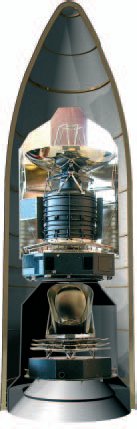
| Fig.1: Fairing of the ARIANE-5 launcher with the HERSCHEL (top) and PLANCK (bottom) observatories. |
The European Space Agency (ESA) launched the HERSCHEL Space Observatory together with the PLANCK mission from the Kourou Space Centre in French Guyana on 14th May 2009 using a single Ariane 5 ECA rocket. The HERSCHEL 3.5 m telescope is operated about 1.5 million km away from Earth beyond the lunar orbit in antisolar direction and it performs observations in the far-infrared and submillimetre range of the electromagnetic spectrum. HERSCHEL is equipped with three instruments: PACS, SPIRE, and HIFI. This project is realised by contributions from a large number of research facilities and industrial companies in Europe and the USA. Among those, the MPIA participated in the development of HERSCHEL’s PACS instrument, a camera and spectrometer for wavelengths from 60 to 210 μm.
The Science Mission
The HERSCHEL satellite is designed to explore the "cool Universe" during its expected 3.5 year mission lifetime. Current estimates of the point in time when the Helium reservoir will be depleted put the end of the HERSCHEL mission to March 2013.
A significant fraction of the Universe consists of gas and dust that is far too cold to radiate visible light or even at shorter wavelengths such as X-rays. Such cold material is associated with the earliest evolutionary stages of galaxies, stars in formation, discs that may form planets, and the atmospheres of comets enriched with complex organic molecules.
The continuum emission from such enshrouded objects peaks in the HERSCHEL wavelength range, and gases with temperatures between 10 and a few hundred K emit their brightest molecular and atomic emission lines there.
In addition, the optical extinction of dust in such sources can be extremely large. At far infrared and sub-mm wavelengths, one cannot only directly study associated physical phenomena, but also the extinction is much smaller.
To achieve its scientific goals, HERSCHEL is equipped with a 3.5 m main mirror and marks the beginning of a new generation of "space giants". Bigger than any of its predecessors at approximately 7.5 m height and 4 m width and a total mass of 3.3 tons, its science payload consists of three instruments: PACS and SPIRE are both cameras and spectrometers that allow HERSCHEL to obtain data in six different spectral ranges in the far-infrared. HIFI is a spectrometer with an extremely high spectral resolution.
Previous space-based infrared telescopes have had neither the sensitivity and spatial resolution nor the ability of HERSCHEL’s three instruments to do such a comprehensive job of sensing this important part of the spectrum. HERSCHEL will bridge the gap between what can be observed with facilities from ground and earlier space missions, such as ESA’s Infrared Space Observatory (ISO) of 1995-1998 and NASA’s ongoing SPITZER mission.
HERSCHEL officially entered the Routine Science Phase (RSP) in January 2010 that was preceded by a Science Demonstration Phase (SDP) in late 2009. First results of the SDP were presented during a workshop organised by ESAC in Madrid, Spain, in December 2009. The first scientific results extracted from observations executed from the HERSCHEL Key Projects during SDP and RSP have been presented at the ESLAB 2010 conference in May 2010. A conference planned for October 2013 will summarise the scientific progress HERSCHEL will have made possible.
Colder than Space
|
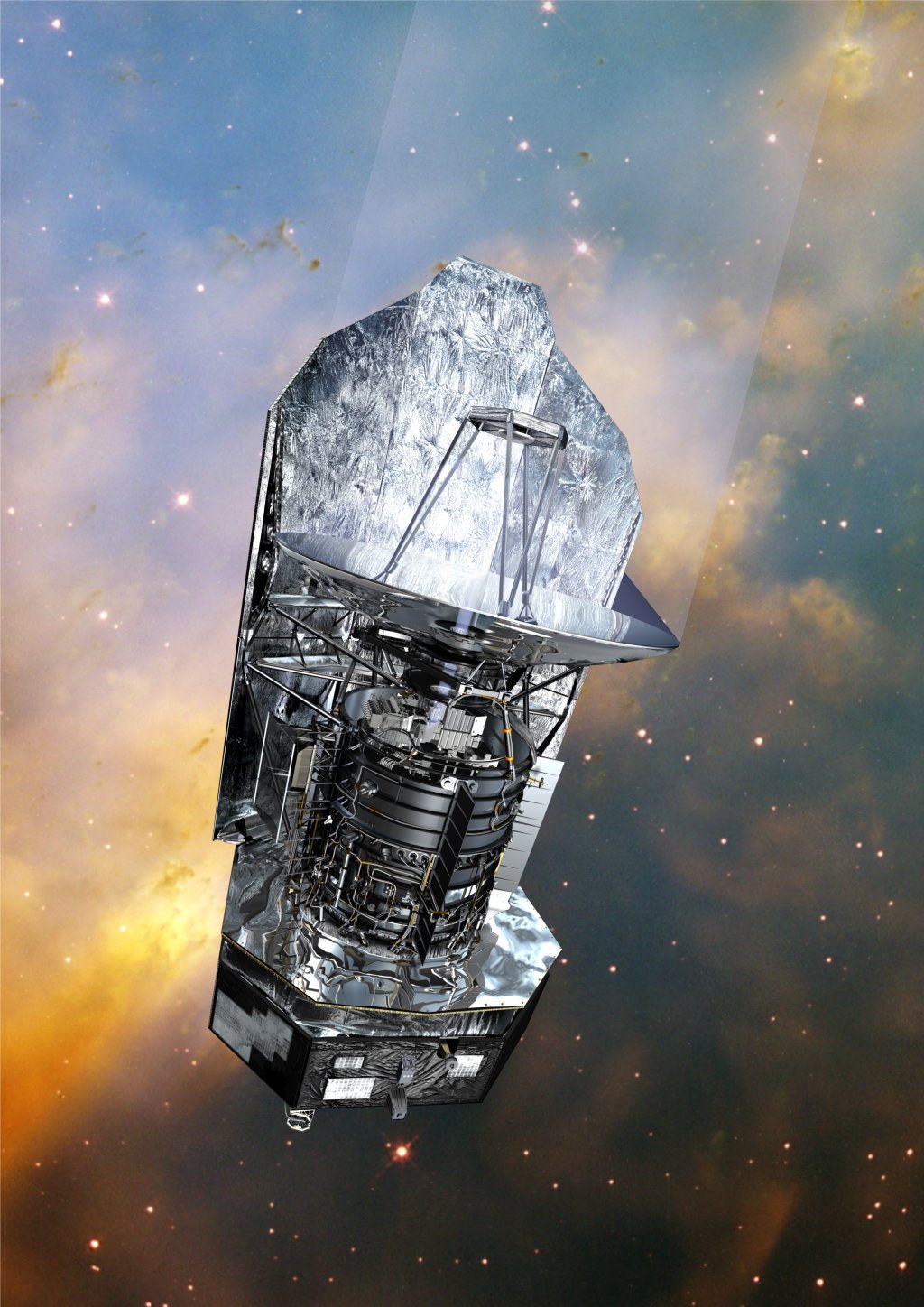
| Fig.2: The HERSCHEL spacecraft is 7.5m high and 4 x 4 m² across, with a launch mass of 3.3 t. The Payload Module consists of the telescope and the cryostat which contains the optical bench carrying the parts of the instruments that need to be cooled. A sun shield protects the telescope and cryostat from insolation and stray light from Earth entering the telescope; it also carries solar cells for power generation. (Click on image to enlarge) |
In order to provide the high sensitivity that is needed to measure the faint heat signatures of the "cold" part of the cosmos, the detectors on HERSCHEL are operated at very low and stable temperatures down to only a few tenths of a degree above the −273°C of absolute zero.
The instruments are contained within a large cryostat (see Fig.2) to maintain the low temperature. Some 2400 litres of superliquid helium (at 1.7K) are being used during the mission for primary cooling. To achieve the very lowest temperatures, individual detectors are equipped with additional, specialised cooling systems.
Protected by a fixed sunshade, the telescope has radiatively cooled to an operational temperature in the vicinity of −188°C (85K). Even under these frigid conditions the thermal radiation background from the telescope is brighter than the observed astronomical sources. To extract their faint signals, sophisticated observing methods have to be implemented.
Location L2
|
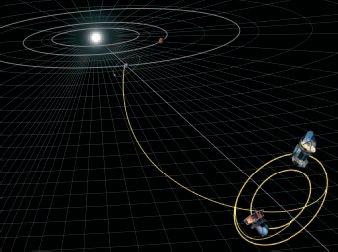
| Fig.3: HERSCHEL and PLANCK revolve around L2 in large orbits at about 1.5 million km distance from Earth. The position opposite from the Sun, Earth and Moon provides stable thermal conditions and uninterrupted radio communications. |
To provide the necessary cold and stable environment, HERSCHEL is orbiting around the second Lagrangian point (commonly known as L2) of the Sun-Earth system. It is located 1.5 million km from Earth on the prolongation of the line Sun-Earth behind the orbit of the Moon.
Consequently, Sun, Earth and Moon, all being intense sources of both straylight and thermal modulation, are always locked in the same region of the sky which greatly reduces their negative effects on the observatory.
The spacecraft follows loop-shaped halo orbits around L2 with an amplitude of about 700,000 km and a period of approximately 178 days. The deviation from L2 as seen from Earth is up to 30°.
Post operations
Science operations have stopped after the depletion of HERSCHEL's Helium reservoir on 29 April 2013. The telescope was put on a heliocentric orbit on 13 May 2013 for which most of its remaining fuel was burnt. The final thruster burn was initiated on 17 June 2013 succeeded by sending the final switch-off command at 14:25 h CEST. However, there is still a lot of work to be done. During the Post Operations Phase that will last until 2017, the remaining main tasks are going to be the consolidation and refinent of the instrument calibration and data processing. At the end, the data archive will contain scientifically validated products with the latest calibration available at that time. click here to get a printer-friendly version of this page click here to get a printer-friendly version of this page |
 for questions or comments please contact the webmaster |